Indigenous businesses in Chile will be able to be recognised in the market: the Seal is now under review by INAPI
TVN covered the presentation of the “SEi · Indigenous Enterprise Seal”, the country’s first certification mark for Indigenous businesses. The application has been filed with INAPI and is under review: the next step is publication in the Official Gazette (Diario Oficial).
By FEi Team
For the first time, Indigenous businesses in Chile will have a seal that makes them recognisable in the market and highlights the value of their products and services. On August 31, 2026, TVN covered the presentation of the “SEi · Indigenous Enterprise Seal”, the country’s first certification mark for Indigenous businesses, whose application for registration has been filed with the National Institute of Industrial Property (INAPI) and is currently under review.
A certification mark is not a commercial logo: it is an instrument that attests compliance with criteria defined by a certifying body, and it is registered with INAPI together with rules of use that set those criteria. That is what was filed. The next step in the procedure is publication in the Official Gazette (Diario Oficial).
The structuring of the mark and its protection system received pro bono advice from the law firm az, as part of the work of Fundación Pro Bono Chile. It was led by the firm’s Intellectual and Industrial Property Group: partner Eugenio Gormáz together with associates Fernanda Rodríguez and Matías Selamé.
“We are very grateful for the az team’s pro bono support throughout this process. Their advice was key to developing a robust certification mark, one that will build trust in the market and contribute to the recognition of Indigenous businesses in Chile.”
Venancio Coñuepan, Executive Director of the Indigenous Enterprises Foundation
Gormáz, in turn, placed the contribution in the criteria: having contributed to an initiative that, in Gormáz’s words, will strengthen the positioning and competitiveness of these businesses under objective and verifiable criteria.
The size of the problem the Seal sets out to solve
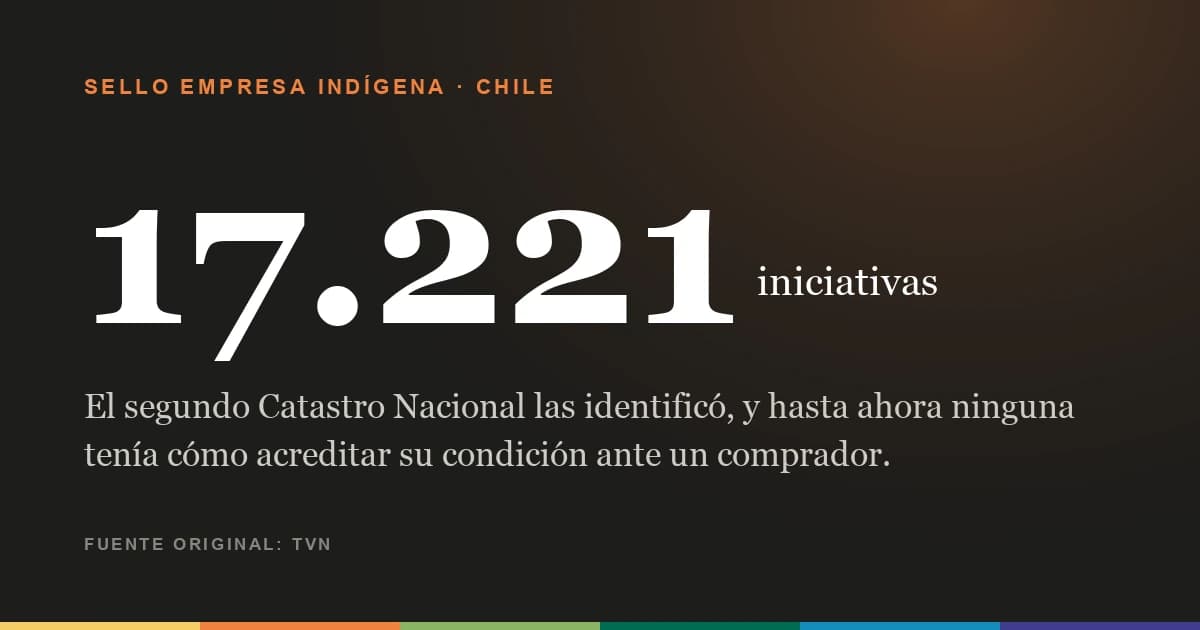
The second National Census, from 2025, identified 17,221 Indigenous economic initiatives in Chile: 564% more than the 2,593 of the first census in 2022, that is, 6.6 times as many. Of these, 84% are led by women. And among those recorded by social development programmes, 97% operate informally.
That 97% calls for a clarification the Foundation always makes, because it is the difference between a data point and a caricature: the figure measures whom the consulted sources serve, which are mostly social programmes, and does not describe the Indigenous economy as a whole. FOSIS, for example, contributes 11,864 of the records and not a single formal business among them. What the number shows is where the State was looking, not how many formal Indigenous businesses exist.
The unit matters too, and here it departs from how it is usually reported in the press. The Census counts initiatives, not businesses: an initiative can be an informal venture, an incorporated company, a producing community or a funded project. Calling all 17,221 “businesses” would be false for almost all of them, precisely because of that 97%.
What is done and what is not
It pays to be precise, because the difference decides whether a business can use the Seal tomorrow. What is done is the application to register the certification mark with INAPI, filed and under review. What is not done is the granted registration, and therefore no business is certified yet: until the procedure is complete, the Seal accredits no one. The Foundation will not say otherwise, not even when a headline says it on the Foundation’s behalf.
The distinction is not a lawyers’ technicality. A seal is worth exactly as much as the market believes in it, and trust in a verification instrument is built by never claiming more than can be backed by a document. A seal announced as finished before it is wears out before it is of any use.
What it verifies, and why the three dimensions go together
The TVN report describes the Seal as intended for businesses whose ownership, administration, control or governance belongs mostly to Indigenous people. The standard is stricter than that list joined by “or”: it requires at least 50% in three dimensions at once, ownership, management and control, and meeting only one is not enough. A business whose capital is 60% Indigenous but whose management and decisions are in other hands does not describe what the Seal certifies.
The 50% threshold matches the one buyers already use (BHP defines an Indigenous supplier as one with over 50% ownership) and the criterion of the councils in the global network, among them Supply Nation in Australia, whose design inspired the Registry. The difference is not where the line is drawn: it is that the buyer counts a self-declared 50%, while the Seal verifies that 50% plus management, control, the public record and the maintenance audit. The Seal’s contribution is not to move the threshold, but to check it.
And that is the underlying reason this is not just another list. What accredits a business as Indigenous are documents requested by its own owner: the certificate of Indigenous status that CONADI issues to the person, or the registration of the community or association with CONADI when it is the owner. The Seal verifies those documents; it does not infer anyone’s identity from the outside, because that cannot be done and it is not its place.
Keep reading
A bridge for Indigenous businesses in Chile and Brazil: the Foundation and Integrare explore how to work together
Indigenous leaders hold a dialogue with Canadian parliamentarians on Indigenous-led economic development