In Australia’s Indigenous businesses, 36% of jobs are held by Indigenous people, and the explanation lies in ownership
Australian research interviewed owners, managers and workers: what sustains Indigenous employment is not a recruitment programme, but who owns the business and how it is governed. The ownership threshold behind that registry is the same one FEi drew inspiration from.
By FEi Team
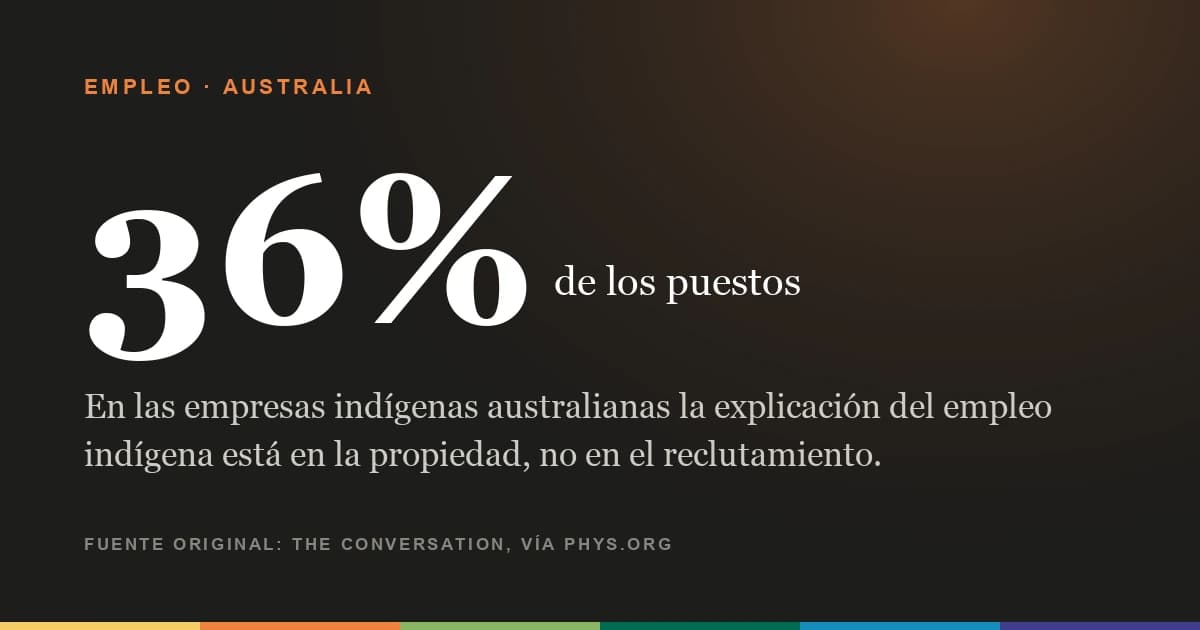
AUSTRALIA. In Australian Indigenous-owned businesses, 36% of jobs are held by Indigenous people, according to research published in the Australian Journal of Social Issues and reported by The Conversation. In the rest of the Australian economy, hiring and retaining Indigenous workers remain an open problem.
The researchers interviewed owners, managers and workers to understand what they do differently. What they found is structural before it is programmatic: flatter structures and a governance that participants themselves described as collaborative, responsive and relational. As a result, those in charge know the cultural obligations and concrete circumstances of the people they work with, and policies adapt to that reality instead of applying a single mould. Workplace flexibility exists in almost all of them, but it is granted differently case by case.
Cultural competence is treated in a way worth noting: interviewees described it not as training or courtesy, but as a matter of workplace health and safety. And they reported marked differences in their experience of racism compared with previous jobs, with managers more attentive to the problem and more committed to eliminating it.
That is where the study’s most useful critique comes from. Many Indigenous employment policies in non-Indigenous companies focus on recruitment, which assumes the problem is the supply of jobs. The authors show that there is no single recruitment strategy, action plan or course that moves the needle: some Indigenous businesses advance their people from entry-level roles to management because they recognise what that requires and what it yields, and creating an entry-level job with no possible career path does not produce the same result.
In The Conversation, the authors, Christian Eva, Jessica Harris and Kerry Bodle, draw the conclusion that non-Indigenous institutions have something to learn from Indigenous businesses: how to be better employers, for Indigenous staff and for everyone else.
What the Foundation reads here
Let us start with the threshold. Formal recognition as an Indigenous business in Australia requires at least 50% Indigenous ownership, the criterion administered by Supply Nation, and most of the businesses listed in that registry are 100% Indigenous-owned. The Foundation’s Registry drew inspiration from that design and added a requirement: the 50% is verified in three dimensions at once, ownership, management and control, not in just one. Public debate tends to stop at the exact point of the threshold; what distinguishes a registry is not where it draws the line, but what it verifies.
What this study adds is that the threshold is not an administrative requirement: it is what explains the result. Where ownership and leadership are Indigenous, Indigenous employment holds up without any programme pushing it. That is a measurable claim, and it is the reason a registry of verified ownership yields more than a hiring policy.
Along the way, it sharpens the argument the Foundation has been making to buyers. Contracting Indigenous suppliers is not a personnel policy: it is a sourcing decision with verifiable results in local employment, and it is defended where it belongs, in the GRI 204 standard on procurement practices, IFC Performance Standard 7 and the ICMM principles. When the same argument is presented as a human resources initiative, it is exposed to the first budget cut.
It remains to say what would make research like this possible in Chile. The Australian study could be done because there is a registry with a verified ownership criterion and a data series behind it. The Foundation’s second National Census, from 2025, identified 17,221 Indigenous economic initiatives, but evidence on employment, retention and career paths cannot yet be produced at that level of detail. That is the practical reason for the Registry, beyond visibility: without it, questions of this kind cannot be answered with numbers.
Keep reading

Communities in Calama and Alto El Loa gain access to 200 training places in entrepreneurship and artificial intelligence
Nineteen families in the Intag Valley own 90% of the hydropower plant they built