Mesoamerican organisations manage more than 36% of the region’s forests and receive 1% of the funding
At the Mesoamerican Exchange on Indigenous and Community Economy, in Panama, the gap was laid bare: almost all the climate finance intended for the peoples is consumed before it reaches the territory. The Mesoamerican Territorial Fund was created to shorten that path.
By FEi Team
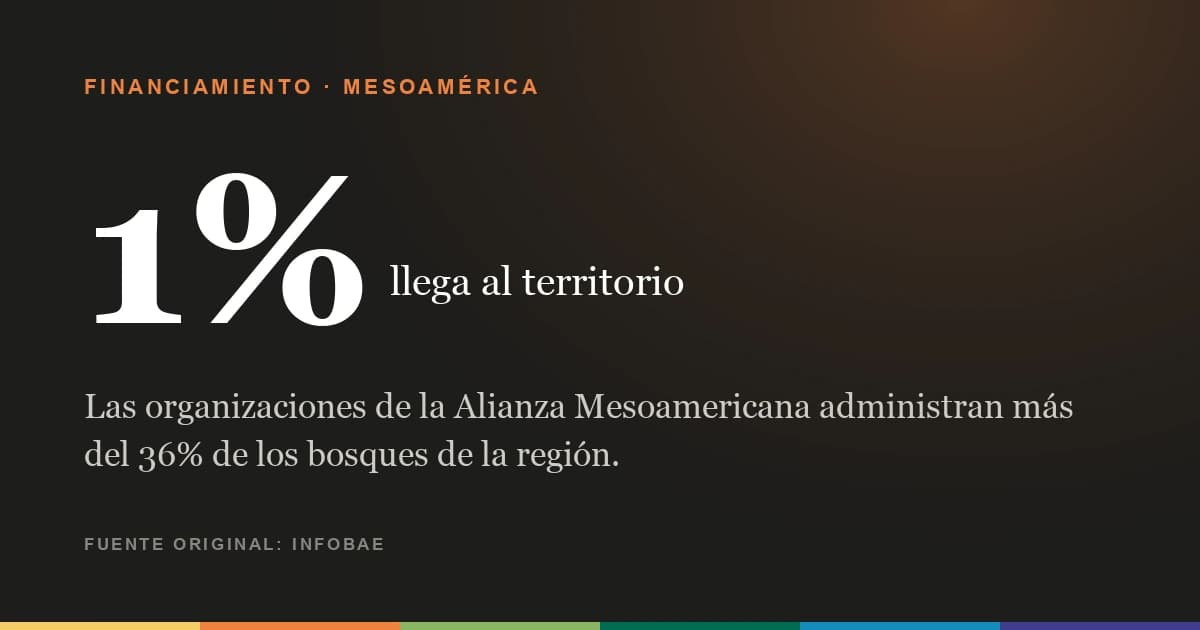
PANAMA, AUGUST 2026. The organisations grouped in the Mesoamerican Alliance of Peoples and Forests hold collective titles or concessions over territories covering more than 36% of Mesoamerica’s forests. Of the climate finance intended for Indigenous peoples and local communities, around 1% reaches those territories directly.
The rest passes through layers of intermediation, administration and studies before reaching the populations in whose name it was raised. María Pía Hernández Palacios, manager of the Mesoamerican Territorial Fund, acknowledges that administrative controls and accountability are necessary, and puts the problem where it lies: when a disproportionate share of the resources is consumed before funding the territorial solutions that justified mobilising them.
The Fund was created in 2023, is designed and led by Indigenous peoples and local communities, and works with more than 35 entities. It started with about US$220,000 to set up its structure and expects to close the year at close to US$3 million. Its policy states that 70% of what it receives goes to territorial investment, and it keeps a four-person operating team to contain administrative costs.
Regional programmes report 56,405 direct beneficiaries and more than 200,000 indirect ones, with more than five million hectares of forest under community management. In Panama they count some 10,000 people, 58% of them women. The resources go to territorial signage and natural regeneration in Emberá territories, to strengthening the Association of Emberá Women Artisans, to local coconut marketing by the Gunadule people and to youth initiatives in Gunayala. The Heart of Conservation project (Corazón de la Conservación), endorsed by Panama’s Ministry of Environment and funded by the Global Environment Facility, begins next year.
“It is not about how many millions we have in each bank account.”
Levi Sucre Romero, Coordinator of the Mesoamerican Alliance of Peoples and Forests
Sucre’s words open the discussion about how results are measured. The Fund is developing biocultural indicators, because for a community the return of a bird species, an improvement in water quality or more young people speaking their language are concrete results, and these advances sit alongside hectares restored and income generated. The meeting also voiced a critique of handout-based approaches (asistencialismo): subsidies may be necessary in certain circumstances, but they cannot be the permanent answer, nor is it right to demand that every community start exporting immediately.
What the Foundation reads here
The 1% names the problem better than any diagnosis: what is missing is not funding, but funding that arrives. And the 70% for territorial investment is a citable governance rule, not an aspiration: it is a percentage written into the policy of a fund run by the organisations themselves, with a four-person team alongside to sustain it. When the design of a mechanism is discussed in Chile, that pair of numbers is worth more than a statement of principles.
Recommendation No. 20 of Chile’s Commission for Peace and Understanding points to the same problem in Chilean terms: the lack of efficient mechanisms for access to financing for projects by Indigenous individuals and organisations. The proposal for an Indigenous Bank of the Americas that the Foundation has put on the table needs precedents of this kind, and what the Mesoamerican case contributes is not the promise of more resources: it is a design where money changes hands with fewer tolls along the way.
Biocultural indicators add something to the discussion of standards. Funders usually bring their own metrics, and when the territory also defines what counts as a result, accountability stops being an upward formality. It is the same principle that governs the verification of an Indigenous business: the criterion is set by those who hold the status, not by the buyer.
One last thing, about tone. Among Indigenous organisations from different countries there is no competition for this space. A mechanism that in three years brought five million hectares under community management is something to draw inspiration from, and to contribute one’s own experience to when the time comes.
Keep reading
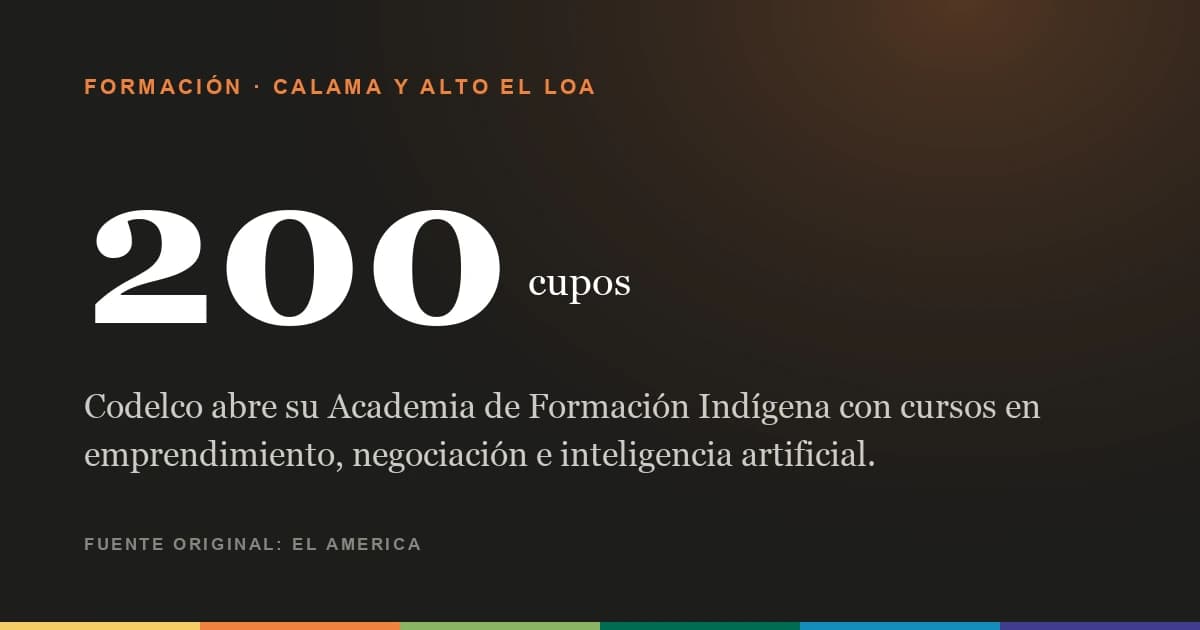
Communities in Calama and Alto El Loa gain access to 200 training places in entrepreneurship and artificial intelligence
Nineteen families in the Intag Valley own 90% of the hydropower plant they built